
The Dark Side of Agile: Returning to Purpose
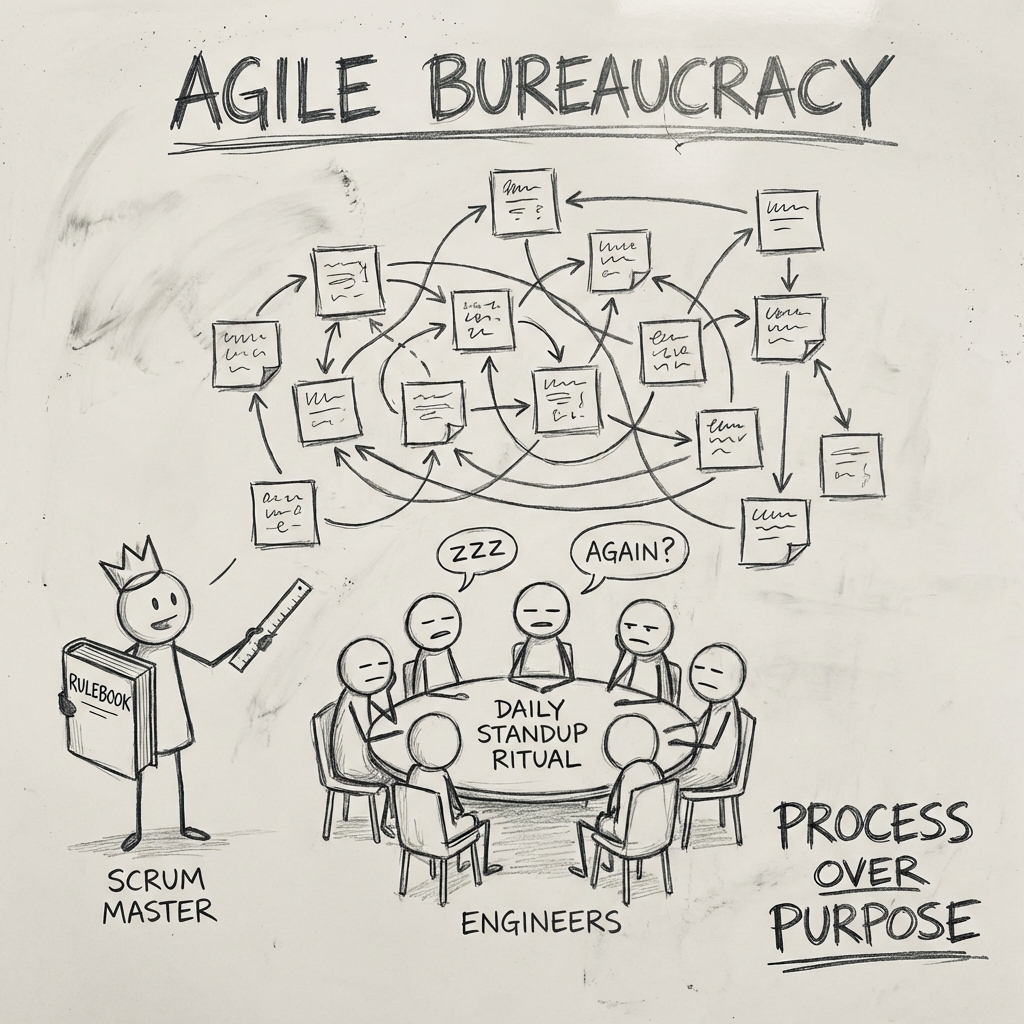
Agile methodologies were born from a desire to liberate software development from the rigid constraints of the Waterfall model. The Manifesto for Agile Software Development (Beck et al., 2001) emphasized "individuals and interactions over processes and tools" and "responding to change over following a plan."
\nHowever, in many organizations, the pendulum has swung too far.
\nThe Bureaucracy Trap
\nWe are witnessing the emergence of "Agile Bureaucracy". Scrum ceremonies have transformed from productive syncs into rigid rituals. Roles like Scrum Masters, originally intended to remove impediments, often become enforcing agents of this new bureaucracy.
\n
The original goal of "doing more by doing less" has paradoxically led to engineers doing busy work to satisfy process requirements rather than delivering value.
\n- \n
- Stalemate with Innovation: Because everyone takes "cushion" in the process, risky but necessary innovation is stifled. \n
- Technical Debt: A focus on velocity metrics often leads to a mounting technical backlog. \n
- Hyper-Visibility: Excessive monitoring forces engineers to "play by the rule book" rather than solve problems creatively. \n
As one industry observation notes, "Agile is a framework, not an off-the-shelf tool." When adopted without customization, we trade the limitations of Waterfall for the limitations of Agile implementation models.
\nThe Evergreen Solution: Chiram OS
\nChiram OS addresses these pitfalls with its Evergreen Enterprise Model, effectively blending the strategic clarity of Waterfall with the execution agility of modern development.
\nAccountability & The OTP Framework
\nChiram promotes accountability at all levels through the OTP (One Team, One Plan) framework. Instead of endless sprint plannings, we focus on:
\n- \n
- Quarterly Planning Meeting (QPM): A dedicated 1-2 day event to celebrate results and commit to the next quarter's goals. \n
- Goal Cascade: Requirements are brainstormed before the quarter begins. Engineers are not left to discover requirements mid-flight. \n
The Power of 3
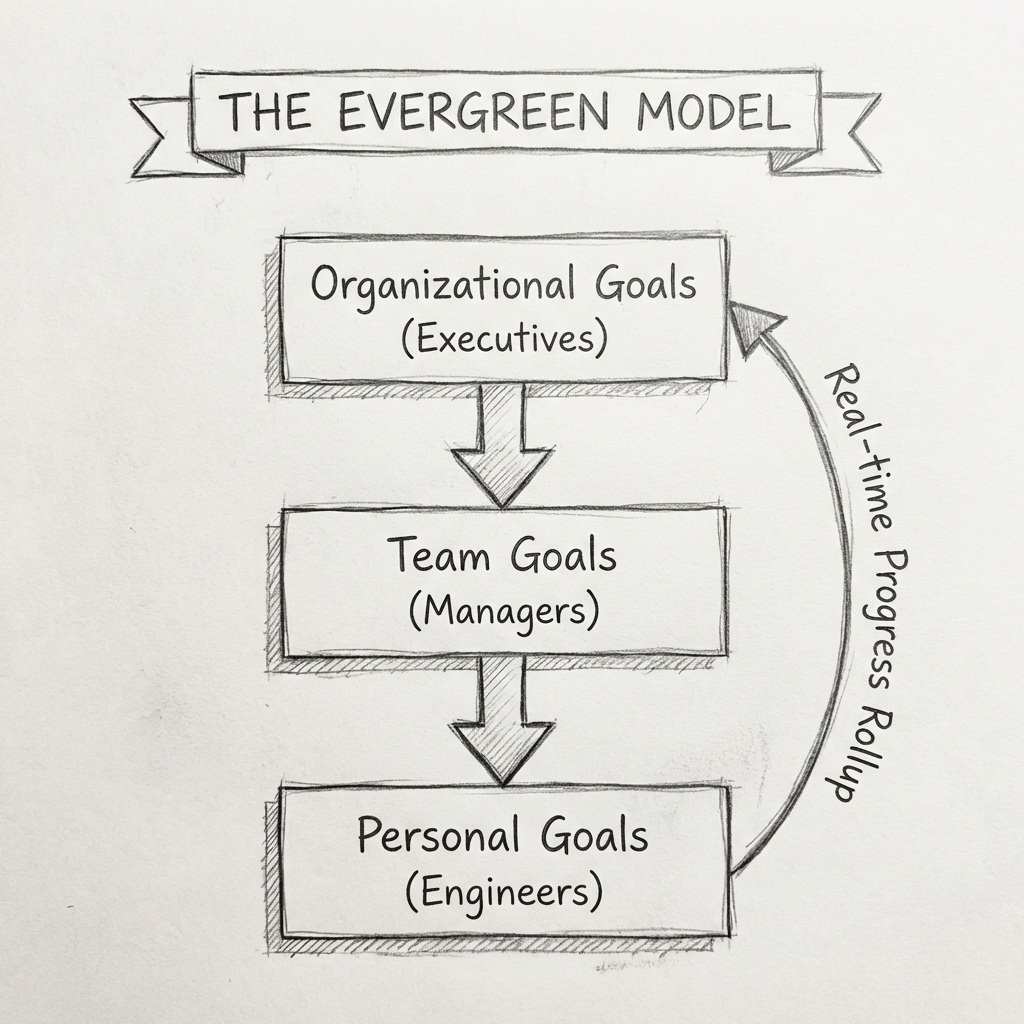
\nTo ensure focus, Chiram enforces a cap of 3 goals per quarter for every entity:
\n- \n
- Organizational Goals (Owned by Executives) \n
- Team Goals (Owned by Middle Managers) \n
- Personal Goals (Owned by Engineers) \n
Every user story is directly linked to a goal. When a story is completed, progress rolls up instantly to the organizational level. This provides executives with clear, real-time visibility without the need for micromanagement or excessive status meetings.
\nBy removing the overhead of ritualistic ceremonies and enforcing clear ownership, Chiram OS restores the core purpose of agile: delivering value.
\n\n
References
\nBeck, K., Beedle, M., van Bennekum, A., Cockburn, A., Cunningham, W., Fowler, M., Grenning, J., Highsmith, J., Hunt, A., Jeffries, R., Kern, J., Marick, B., Martin, R. C., Mellor, S., Schwaber, K., Sutherland, J., & Thomas, D. (2001). Manifesto for agile software development. Retrieved from https://agilemanifesto.org/
Published in Business Agility • 2/1/2026
Comments (0)
Leave a thought
No comments yet. Be the first to start the conversation!